Abide in My Love

Edina Morningside Community Church

Today’s scripture reading:
John 15:1-17
Sermon audio:

Javen and I have made a couple mistakes with our little rosebud tree. A few years ago, we decided to replant the gardens around our house, and our biggest investment was a dwarf rosebud tree next to the front entrance. It’s not supposed to get more than 8 feet tall, with fluttering heart-shaped leaves and sweet little pink buds that come out early in the spring. But in the last several years, we realize we still planted it too close to the house foundation. It’s not able to thrive if the roots are cramped against the concrete, not given room to grow. Also, the tree had misshapen leaves throughout the entire last season. We recently got the results of a test back, and it appears that mites had infested the tree. These little mites are smaller to see than aphids, but they had sucked out all the sap leading to the leaves, leaving the leaves cupped and unable to bend open or soak up the light. Our sweet tree is a pitiful shadow of what it could be, judging from the advertised pictures when we bought it.

Continue reading “Abide in My Love”

Come and See

Edina Morningside Community Church

Today’s scripture reading:
John 9:1-41
Sermon audio:

A company called Second Sight has been working for years on technology that gives sight to the blind. The model they are testing has cameras implanted in a pair of glasses. Images are then wirelessly broadcast to a receiver that’s implanted in the surface of the eye, which sends them through the retina to the brain. Those who once were blind are now able to see—well enough to go skiing, take up archery, and move around at will.

Continue reading “Come and See”

Come and See as Jesus Sees

Edina Morningside Community Church

Today’s scripture reading:
John 4:1-42
Sermon audio:

We start today with a puzzle of biblical geography. John’s gospel says that Jesus had to go through Samaria, but that’s just not the case. In the last chapter, Jesus was in Jerusalem and had that midnight conversation with the Jewish leader Nicodemus. Now we’re told that he leaves Judea and goes north again to Galilee. Any reasonable traveler between those two regions would have used either the coastal route along the Mediterranean, or the inland route along the Jordan River. Both are well-established paths of trade and travel, easier to navigate than the high hill country between them and to the east, which was Samaria. So when John writes that Jesus “had to go through Samaria”, that’s like a travel agent sending you from Minneapolis to Duluth, through Fargo. Something else is afoot. If Jesus does have to go through Samaria, it’s because of who he will meet there.

Continue reading “Come and See as Jesus Sees”

Come and See What You Can Be

Edina Morningside Community Church

Today’s scripture reading:
John 3:1-17
Sermon audio:

The global visionary, humanitarian, and writer Danaan Parry uses the imagery of a trapeze artist to describe how humans navigate through growth and change. He swings along, Parry writes, hanging from a bar that symbolize confidence and certainty. But then the trapeze artist sees another bar swinging towards him. “…I know, in that place in me that knows, that this new trapeze bar has my name on it. It is my next step, my growth, my aliveness coming to get me. In my heart of hearts I know that, for me to grow, I must release my grip on this present, well-known bar and move to the new one.” But letting go of a thing that’s certain requires surrendering control and knowledge. It means hovering in a space where the past is past, but the future is not yet seen. Parry concludes, “Perhaps this is the essence of what the mystics call the faith experience. No guarantees, no net, no insurance policy, but you do it anyway because somehow to keep hanging on to that old bar is no longer on the list of alternatives. So, for an eternity that can last a microsecond or a thousand lifetimes, I soar across the dark void of ‘the past is gone, the future is not yet here.’”

Continue reading “Come and See What You Can Be”

Come and See Faith Set Free

Edina Morningside Community Church

Today’s scripture reading:
John 2:13-22
Sermon audio:

What do all these things have in common: horses, currency, the compass, the telegraph, internal combustion engines, radio, the Internet, and smartphones? These are all examples of “disruptive technology”—transformational new methods of trading, traveling or communicating. They have an outsize impact on the history of civilization, changing the course of human activity in revolutionary, unforeseen ways. Fifty years from now, which of these will be added to the list: virtual reality, artificial intelligence, 3D printing, gene editing, or driverless vehicles? Which of them will have the effect in the 21st or 22nd centuries that the printing press had in the 16th century? It’s easy to recognize disruptive technology after-the-fact, but we are surrounded by such innovations in their infancy today.

Continue reading “Come and See Faith Set Free”

Come and See God’s Glory

Edina Morningside Community Church

The day’s reading:
John 2:1-11
Sermon audio:

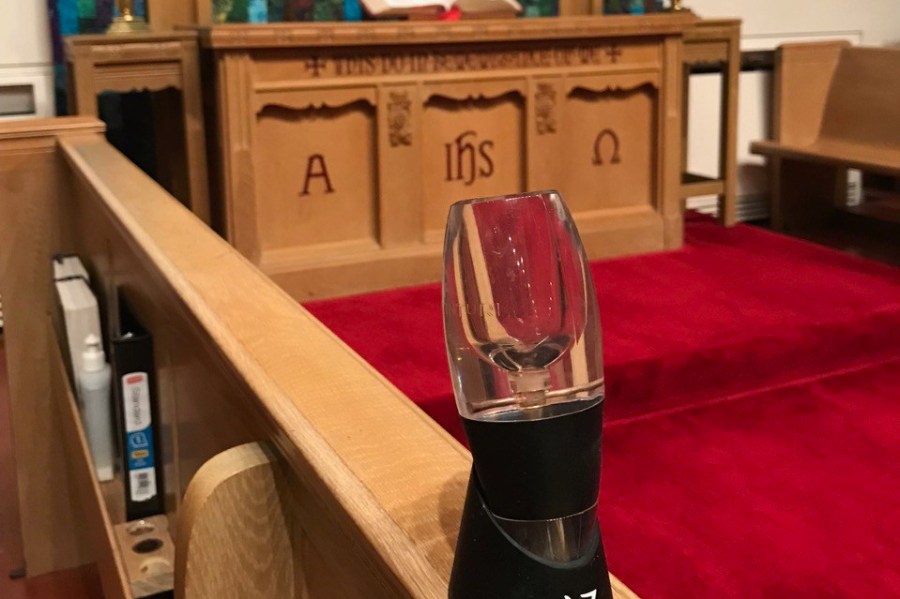
Does anyone recognize this? Do you know what it is? A wine aerator! I forget who first taught me about this, but somewhere along the way I learned that there’s more to wine than just the taste after it comes out of the bottle or bag. Pouring through an aerator such as this adds oxygen to the wine, which changes how it tastes. With such intention and care, wine “blooms” with fully-developed fragrance and flavor. Javen makes fun of me for bothering with an aerator, but I’m certain that his taste remains unrefined. After years of using one, I find it disappointing to drink non-aerated wine, because it seems to forego the potential in the glass. Admittedly, this is a silly, first-world gadget. But I love the way it makes even common table wine taste like a rare and complex vintage, using nothing but air and a little bit of time. It’s delightful to discover extraordinary potential in the ordinary things of life.

Continue reading “Come and See God’s Glory”

More Life

Edina Morningside Community Church

Today’s scripture reading:
Matthew 2:1-23
Sermon audio:

I always find this week to be a weird one, don’t you? It’s a sort of limbo time, between the high points of Christmas and New Year’s. Christmas is the finale after weeks—or months—of preparation, and New Year’s is the launch of a brand-new start, but in between them are these quiet, unremarkable days. For many families, this week involves travel—coming home from a Christmas trip, seeing the other side of the family, or going to wherever one will spend the rest of the winter. Even if this week has not literally held travel, it still feels like the hours on a trip between departure and arrival, when everything is in motion and nothing is settled yet.

Continue reading “More Life”

Swaddling Cloth Savior

Edina Morningside Community Church

Today’s scripture reading:
Luke 2:1-20
Sermon audio:

Earlier this month I attended one of the Christmas concerts put on by area colleges this time of year. In between the musical pieces, narrators read various biblical passages, including the Christmas story that we just heard. As I listened to verses from Luke’s gospel for the umpteenth time, I heard something I’d never paid any attention to before. Tucked in there among registrations, Nazareth, Jerusalem, shepherds and angels, there’s a little, overlooked mention. Mary gives birth to the child, “and wrapped him in bands of cloth” before laying him in the manger.

Continue reading “Swaddling Cloth Savior”

More Hope

Edina Morningside Community Church

Today’s scripture reading:
Luke 1:5-25, 57-66
Sermon audio:

By January of my senior year in high school, there was so much to be afraid of. I was approaching graduation and should have been looking forward to college, but all I could think about was how I didn’t fit in, and my fear that I would never fit in. For years I’d known that something was different about me; I didn’t match the cultural expectations of my surroundings in Great Falls, Montana. Months earlier, I’d finally dared to name the difference: I was having crushes on men rather than women. But this realization brought no comfort—it set off waves of daily, fervent prayer. Admitting I was gay would make me a target for bullying at school, would cost me relationships with family members and classmates, and would not fly at all in the church where I’d become a youth leader. So night after night I prayed for change, but the change never came. I feared I would always be as I was then—confused, hidden and alone.

One Saturday night in January 2001 I again found myself praying to be something I was not. I was thinking ahead to church the next morning, and how I’d feel like a fake when I showed up to sing pious hymns to a God who I feared would never answer my prayers. But that night, painful isolation opened to a new possibility. It was as though I heard God saying to me: “If I haven’t taken this gay thing away after all your prayers, it’s not because I’m not able to, but because I don’t want to. What if this is a gift, rather than a curse? What if you are supposed to learn to live with this, rather than flee from it?” In my youth group, I’d learned that God was sending messages all the time, and my job was to pay attention so as not to miss them. So I took it as a clear sign when I opened my clothes drawer and lifted out to wear the item which happened to be on top. It was one of the many evangelical Christian t-shirts I had in my collection then. Under a great yellow cartoon smiley-face were the words of a psalm: “He has made me glad.” That morning getting dressed for church, I read it in a different way: “He has made me gay.” God had answered my prayer, but not in a way I could have imagined or accepted at first. Fear at the ways I didn’t fit—and dread of a friendless future—would pass. I could be myself, and God would make me glad.

Have you ever had a moment like that, when you turned around a corner inside from dread to possibility? Can you recall times of such transformation, when life seems to divide into “before” and “after”? Was it a diagnosis, a birth or death, news of a job, a meeting of the eyes, or a paradigm-shifting conversation? Such moments are daunting because they call for us to change, yet they are also exhilarating because they unlock new paths for the future. They are glimpses of divine possibility which give us cause for new hope. This is our faith that God’s tomorrow may transform our today. It is the hope with which we start every Advent season, anticipating the coming birth of Christ. As Marcia McFee writes, “Advent can remind us that God makes us ready for whatever unknown may come our way, and calls us to be messengers of #morehope in an ever-changing world.”[1]

Zechariah knows what fear and dread of the future are like. In his day, Israel had been reduced from worldly success to a conquered people. Roman rulers called the shots, and Hebrew worship continued only because Rome allowed it. That’s how it had been Zechariah’s whole life. Every revolution for freedom had failed, and the temple priesthood was complicit in propping up Caesar’s power. Even when Zechariah was chosen to perform the ultimate duty, to enter the holiest of holy rooms in the middle of the temple, he did so with little expectation that anything would change. Rather, he entered with dread that things would always be the way they had always been.

No wonder he was dumbfounded by the angel’s appearance! Even this man of God could not believe the future foretold here. An old man just going through the motions, Zechariah receives Gabriel’s announcement that he’s a part of something much greater—God is doing something new. Zechariah and Elizabeth will bear a son in their old age. Their child is the one we call John the Baptist, a messenger for the coming Christ who will be a savior for the people. Elizabeth and Zechariah learn that God does not just go through the motions. Rather, when divine angels arrive they come with unexpected power, and a transforming call to become carriers of hope in God’s name.

But’s it’s hard to believe, isn’t it? No wonder Zechariah lost his voice at first. This faith we follow is so often unspeakable when hope-less-ness and cynicism are widespread in the land. Then especially, we struggle to believe for ourselves, or at least to voice what gives us faith, hope, meaning and purpose. Zechariah’s protest that he is old and beyond the age of raising children is just another form of what we start to believe ourselves. “I’m not good enough.” “God couldn’t really be interested in my life.” “What can one person do?” Fear that the future will be like the past leads to hope’s opposite: despair. We become complicit in silencing ourselves, in foreclosing possibilities by telling ourselves how great are the troubles, and how overwhelmed we already are. That is precisely the moment we need to hear the message of the angels: #DoNotBeAfraid.

I suspect for most of us, the angels do not show up in ethereal, feathery form. In my case at least, tidings of #morehope came from physical and familial messengers. God may have been telling me that gay was okay all along, but even though my heart was changed in prayer, I couldn’t really believe it until angels in human form showed it to me. Until my mother said, “Are you sure you’re gay? Okay, maybe we should go shopping sometime!” Until my grandmother said, “Of course you can be gay and a pastor; there’s nothing wrong with that.” Until my mentors in faith helped me find welcoming congregations. Until the United Church of Christ said “No matter who you are, or where you are on life’s journey, you are welcome here.” Until I’ve been transformed into a messenger too, with the promise that God offers us #morehope this Advent season, and we need never be afraid.

As we begin this Advent season of anticipation, whether we are daunted by all that is afoot in the world or still high on the best of Thanksgiving—family, turkey and cranberry wine—we are called to receive and share the same message of the angel to Zechariah, #morehope. Advent starts with this extraordinary story of God at work in the midst of very ordinary people. One person can and does make a difference, no matter how insignificant our contributions seem. So consider one another as we close, and consider this world in which we find ourselves now. Consider how we might share more hope in the next hour, next day, next week, and all this next season. There are angels among us, with a divine calling. God is making us ready to be messengers of hope through our words and actions, flying in the face of fear in an ever-changing world. Amen.

[1] Marcia McFee, “Angels Among Us” worship series (Worship Design Studio; 2017).
Future-Tense Faith

Edina Morningside Community Church

Today’s scripture reading:
Isaiah 9:1-7
Sermon audio:

One of my friends, Scott Spence, is also the pastor of a UCC church. He sent a message this week asking how I was handling this text, since both our churches use this schedule of readings called the Narrative Lectionary. We’ve preached on Isaiah, chapter 9, but it’s usually in a different context. It’s usually read alongside another story, famous for its shepherds, stable, manger and baby. Scott asked what I was thinking about preaching this week because, he said, “I just keep wanting to preach a Christmas Eve sermon.”

Scott might be a month ahead on the calendar, but it’s easy to understand the connection to Christmas. This is the very text set to glorious music in Handel’s “Messiah”, used as foreshadowing for Jesus’ birth and sung so frequently in the holiday season. But Scott’s getting ahead of himself is a more profound impulse also. There is a deep current of forward movement, of anticipation, in the Christian faith. We are always looking ahead to the fulfillment of God’s promises. Christianity looks around at the world as it is and proclaims that there is more than meets the eye. Not this only, or this, or this, but that off in the future, envisioned with the eyes of faith and held in the heart. It’s the sense of ultimate hope depicted at the end of the Bible, in those words of Revelation promise so often read at funerals: “Death will be no more; mourning and crying and pain will be no more, for the first things have passed away.” The Christian faith is lived with future tense.

We get that future faith from our Hebrew ancestors, including the prophet Isaiah. He too looked around at the world of his day and looked ahead to something else. The two Hebrew kingdoms of his day, split by civil war, would not be divided forever. The foreign adversaries with boots of war and garments soaked in blood would not prevail forever. Listen to the future tense with which Isaiah prophesied here: “there will be no gloom for those who were in anguish.” God “will make glorious” the lands of Palestine. Isaiah can see the light of tomorrow dawning though the times he lived in were bleak as midnight.

Except for this. If we start studying the grammar of Isaiah’s prophecy, we’ll recognize that future, present and past tense get all mixed up. The future is being realized even now, and has been realized already! So Isaiah says, “the people who walked in darkness have seen a great light”; “on them light has shined”. He says to God: “You have multiplied the nation, you have increased its joy.” “You have broken” the yoke of burden, the bar across shoulders, the rod of the oppressor. Isaiah recognizes God’s action in the past, raising up a savior—in this case likely a military ruler, though Christians connect the prophecy to Jesus. “A child has been born for us, a son given to us.” But the future fulfilment is not yet realized: “his authority shall grow continually, and there shall be endless peace for the throne of David and his kingdom. He will establish and uphold it with justice and with righteousness.”

Isaiah shows us what is sometimes called “the now and the not yet” of Christian faith. God is present and active right here and now, but the full realization of God’s promise is not yet at hand. We hold with one hand “in the sweet by and by when I die”, and in the other hand “down on the ground while I’m still around”! The faith that there is more to come carries us through seasons of heartsickness when all seems in trouble. Yet the promise of God’s manifesting right here and now can keep us from being “so heavenly minded that we’re of no earthly use”. “Now” and “not yet”—held in faithful balance with one another.

This season in the church’s life feels full of such promise and realization. With Thanksgiving Sunday and all the gratitude that we extend this week, we number the blessings of the past year: abundance in capital campaign generosity, growth in worship, Spirit and members, those in need of care held with perpetual love and prayer. Over coffee and conversation each week in Bible study and at fellowship time, we name the brokenness of the world as it is, yet also point with gladness to what hopes are being born anew in it. Our confirmation youth—on an urban retreat this weekend—have experienced firsthand how hard it is to live in poverty in Minneapolis, yet also volunteered to make it better, serving food and cleaning at a homeless shelter yesterday. The Divine Design Task Force has been meeting with possible architects this week, interviewing candidates to help us remake our entrance and narthex to be more welcoming and serviceable. We are counting the blessings of the past and acknowledging limits of the present, while building with our pledges and hopes for the future. We are practicing both the “now” and the “not yet” of our faith.

Listen in closing to these words of wisdom in a hymn by Natalie Sleeth, which sees the future in the present moment.

In the bulb there is a flower; in the seed, an apple tree;
in cocoons, a hidden promise: butterflies will soon be free!
In the cold and snow of winter there’s a spring that waits to be,
unrevealed until its season, something God alone can see.

Faith that God holds the future is what gives us hope in the present moment, while knowledge that sees God among us even now spurs our participation to join God in making the best possible tomorrow. This is the faith that we inherit from Isaiah, Jesus and all our ancestors. This is the faith that we live by, pulling us into tomorrow. This is the faith by which we share every good thing. This is the faith that helps us trust the promise of Christmas Eve, even in the days before Thanksgiving. For such faith, we give all thanks to God. Amen.