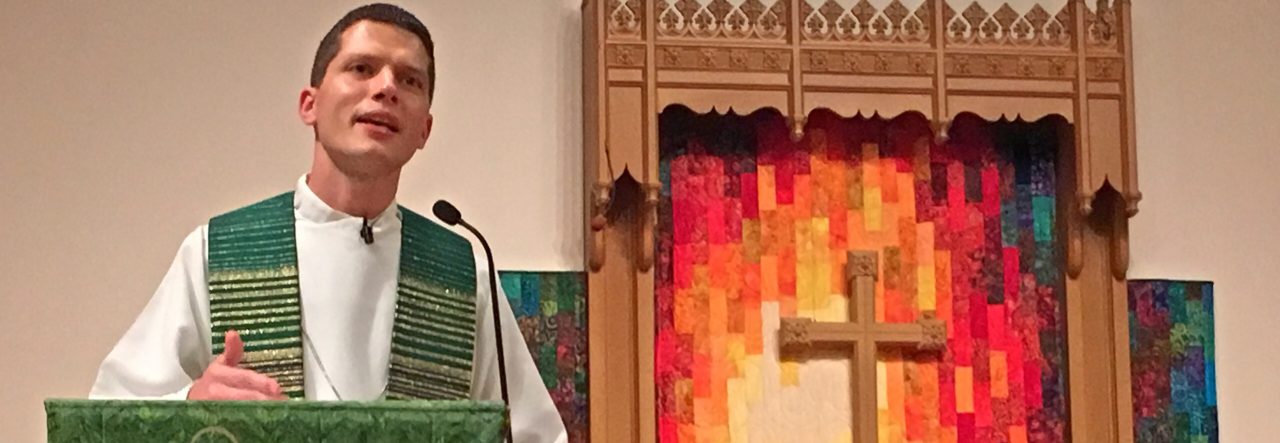
Good morning! If there’s one theme that flows through today’s passage (Ezekiel 28-31), it’s that line from the book of Proverbs: pride goes before a fall. By turns one nation after another is called out for getting “uppity”, and each time it ends in disaster. Tyre, Egypt and Assyria are all characterized as being so cocky that they need to be humbled by God, acting through the means of Babylon. That confident and successful nation will have its reckoning too though, since its pride too will lead to a fall.
Author: Oby Ballinger
Ezekiel 24-27
Good morning! Can you believe we are nearing the end of the Hebrew Scriptures? It seems like we’re just going along as steadily as ever, but in truth we’ve got only a few more weeks of Old Testament texts before we turn the page to Matthew’s gospel and the stories of Jesus. That’ll start on October 1st, and all are welcome to join in reading through the New Testament in the last three months of the year, even if it’s been a struggle to keep up through the Old Testament.
Ezekiel 21-23
Good morning! Today’s passage (Ezekiel 21-23) heavily inveighs against Judah for a long list of sins and wrongdoings committed contrary to God’s law. Some of these are moral flaws, but others are ritual failures, which Ezekiel is somewhat unique among the prophets for pointing out. Priests have colluded with sinful kings and everyday people to bless misbehavior. They have failed to uphold rituals, “made no distinction between the holy and the common, neither have they taught the difference between the unclean and the clean, and they have disregarded my sabbaths” (22:26). Because of these and many other sins, Ezekiel declares in chapter 21 that God’s sword is preparing to wipe out every living thing in Judah. Think of this as an ancient form of the “doomsday clock” updated regularly by atomic scientists to show how close nuclear weapons and other threats are to wiping out human life on earth.
Ezekiel 18-20
Good morning! Today’s passage (Ezekiel 18-20) continues both themes from the past several days. We see here a description of divine justice that only takes into account the righteousness or wrongdoings of a given person, freeing subsequent generations from paying the burden incurred by sinful ancestors. We also see several parables in Ezekiel 19, though neither of them plays on the distasteful assumptions of domestic violence that were the cornerstone of yesterday’s texts. The parables speak for themselves, so I’ll focus on the new order of things, as presented in Ezekiel 18 and 20.
God announces in Ezekiel 18 the retirement of a punishment system whereby children bear the brunt for sins their parents commit. Now, according to the prophet, each person is responsible for the hardship them themselves cause. A new maxim comes to the fore: “The person who sins shall die.” Therefore, a person has greater control over their happiness, since their only responsibility is for their own actions. By maintaining the moral code epitomized in the ten commandments, and the purity code laid out in Leviticus and Numbers, a person “shall surely live, says the Lord God.” Furthermore, God recognizes the honest repentance and redemption of sinners, equipping everyone who asks to grow in a new way.
How ironic then that in this dawning age of “personal responsibility”, Ezekiel 20 suggests the sins of ancestors are what keep God from having mercy on Israel! This suggests the overlap of competing narratives, not all of which are settled at the time of Ezekiel’s final composition. I find fascinating the suggestion that some of the laws and commandments given to Israel were false ones, made to test the obedience of the Hebrew people. I hope this applies to child-sacrifice practices in particular! Through further obedience, God promises a regeneration of Israel and their old ways. The chapter ends with a curious little curse from Ezekiel on the land of the Negeb, following God’s orders. Happy reading
Please join discussion of this passage at the Daily Bible Facebook group, or comment below. The passage for tomorrow is Ezekiel 21-23. Thanks for reading!
Ezekiel 15-17
Good morning! Today’s three chapters (Ezekiel 15-17) deploy detailed metaphors to describe Jerusalem’s relationship to God. Prophets use metaphors and analogies with some regularity. They are accessible to more people and have a way of sticking in the imagination. Jesus himself used metaphors often in teaching—he used them in stories that we now call “parables”. They play on everyday experiences and knowledge (such as that of vines, eagles and trees in chapters 15 and 17) to illumine and persuade in the course of a conversation. This is how vines, eagles and tress in chapters 15 and 17 convey feelings about Jerusalem’s disobedience of God and conduct during Babylonian occupation. So far, so good. However, the metaphor that gets such detailed exposition in Ezekiel 16 plays on anti-woman stereotypes that (thankfully) have diminishing traction in communicating anything about the divine. Comparing Judah to a loose woman ignores the actual experiences of “comfort women” and others whose bodies and souls suffered from the conquest of one invading army after another. Furthermore, such a construct limits how we understand the roles that God might play in liberating all who are oppressed, women especially.
Ezekiel 11-14
Good morning! Today in Ezekiel 11-14 we hear retold many of the same narratives we’ve read before, just from a different prophet’s mouth. We see a sign-act that dramatizes the desertion of Zekediah and the succeeding events that ended his reign, as demonstrated in Ezekiel’s highly visible departure from Jerusalem. We hear also about divine judgment, false prophets, and God determining to put hearts of flesh in place of stone hearts. All these have been shared before in different contexts. But what strikes me as different in these chapters of Ezekiel is an emphasis on the individual over against the community—first the prophet himself, and then other exemplary individuals from Hebrew history.
Ezekiel 6-10
Good morning! Ezekiel’s messages about Judah and Jerusalem continue in today’s passage (chapters 6-10), and indeed they extend all the way through Ezekiel 24 before the book takes a new course. Yesterday I noted that Ezekiel holds together both priestly and prophetic concerns. Today, we can see his prophetic critique of wealth alongside the priestly sensibility of keeping the temple pure from idols. In the presence of both corrupting wealth and idolatry, Ezekiel envisions God cutting the people of Jerusalem off entirely, with only the exiles left as witnesses of the true God.
Ezekiel 1-5
Good morning! Today we start the book of Ezekiel, with a healthy dose of chapters 1-5. More than any other in the Bible except for John the Seer in Revelation, Ezekiel leads me to ask, “What was he smoking??” His fantastic visions artistically combine natural and supernatural phenomena, all in an effort to communicate God’s messages to the Hebrew people around him in Babylonian exile. Unique for his time, Ezekiel combines both priestly and prophetic impulses. He’s committed to that “old-time religion” of temple rituals and piety, but also wants them to create more faithful and righteous daily behavior.
Lamentations 4-5
Good morning! Today, I invite us to read Lamentations 4 and 5 as Swiss theologian Karl Barth suggested that preachers preach: with the Bible in one hand, and the newspaper in the other. In the last several days, it has been hard to miss news stories about refugees and migrants—from America to Italy to Syria and beyond. The heartsickness and grave physical destitution of displaced peoples today and of residents in ancient Jerusalem is all from the same cloth. It comes about through warring violence as a direct cause, yet there are primal social sins at work as well.
Lamentations 3
Good morning! We have only a single chapter today, Lamentations 3, but it covers huge ground in terms of personal feelings toward God. I find myself disagreeing with some sentiments, agreeing whole-heartedly with others, and ultimately finding grace in the fact that one can express all these emotions in deep relation to God.

