Open and Affirming: Past and Future

Preached at First Congregational United Church of Christ (Moorhead, Minnesota). Texts: Genesis 9:8-16 and Mark 12:28-31

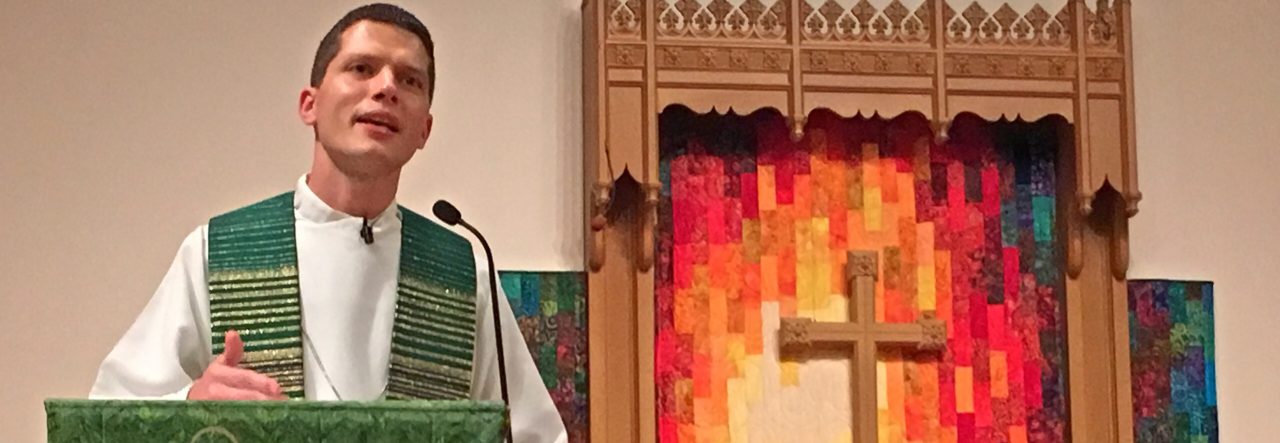
In September 2001, I completed a move from Great Falls, Montana to Moorhead here, and started schooling down the street at Concordia College. The first couple days of classes were the usual overwhelm you can imagine—a new school, new place, new friends, and new studies. But then on September 11th, the rest of the world and I sat in bewilderment as we tried to make sense of terrorist attacks that would change world history. The next Sunday, I went looking for a church that would help me make sense of what was going on. That cool September morning, walking north from Concordia, I was heading to St. John the Divine Episcopal Church north of here. But as usual I was running behind, and would be late for that service. Walking past on the sidewalk, I noticed that worship here was also at 10am. I’d be on time here, and I could always go to that other church the following Sunday. So I looked up the stone steps, heard chatting and a friendly invitation, then entered through the open front door. In all the years since, I have never made it to St. John the Divine.

Continue reading “Open and Affirming: Past and Future”
A closeup picture of a quilted stole, showing rectangles of fabric in blues, purples, and other colors.

Known, Called, Commissioned

Sermon preached at Newport United Methodist Church and Community United Church of Christ in Newport, Minnesota.
Text: Jeremiah 1:4-10.

I have an embarrassment of riches when it comes to clergy stoles—so many beautiful and lovely fabrics to wear as symbols of God’s call to ministry! When I left parish ministry to begin full-time faith community organizing,
I hung them up in my closet and wondered when I would wear them again. So when Pastor Anne reached out to ask me to preach and share communion this morning, I’m just vain enough to start asking, “What should I wear??” In most Protestant churches, the Epiphany season of growth and wisdom is marked by the color green. So I went to the green and gold stole that a mentor gave me at my ordination, with the reminder that green is worn most often throughout the year. But I was also drawn to this other green one made by a pastor friend in Duluth, which includes the rainbow colors, fabric showing love, the spiral way of faith, and the Black Lives Matter salute that communicates resilient determination. Then again, anticipating seeing here some of the dear Community UCC members, who ordained me fifteen years ago last month in a sanctuary just down the road, made me reach for another stole that the church’s moderator there once gave me: “Blah, blah, blah”! (I think it was a joke?) Finally, Pastor Anne told me that the color for the day was every color—the rainbow! So I have opted for this stole of rainbow colors, made by a gay man in the congregation where I taught Sunday school while in seminary. You may not be able to see it from farther away, but this stole is made of hundreds of small colorful fabric squares, all stitched together by painstaking work into a colorful and diverse tapestry.

Continue reading “Known, Called, Commissioned”

“When news is bad” (Steve Garnaas-Holmes)

There are a thousand articles and social media posts from pundits and politicians trying to make sense of why the presidential election last week took the turn that it did, and positing the way forward. I’ve read a few of them, and no doubt will read more in the coming weeks. I’ve even written my own near-term reaction piece on Trump’s reelection. But I’ve found myself needing instead to first sit with grief that my neighbors in America have made such a bewildering choice, and to tend to the soul before attempting to diagnose society or chart a course to follow. Into this moment I’ve been grateful to discover this poem by the retired Methodist pastor Steve Garnaas-Holmes. I’m not certain that it was written in the last week with the election in mind–it serves for any time when the news is bad and we need reminders of how to respond with our full humanity.

Take seriously your grief.
It is love, stripped bare.
Let it flow through you.

Trust that you are held.
We all are held by the Beloved,
the Broken-Hearted One,
the One who Suffers most Deeply.

Know you are not alone.
Millions bear your sorrow.
Ancestors and even unborn generations
walk with you gratefully.

Seek others who are tenderhearted.
Receive all the grace you can.
In the flesh is best, but even in spirit,
know we are here.

Trust the Goodness.
God has not given up on us.
Through every disaster grace remains.
Refuse to despair.

Choose courage over selfishness,
trust over fear, love over anger.
You do not know the end of grace.

There is much you cannot change,
but bring healing where you can.
We are not promised to be given light,
but to shine with light.

Don’t become an enemy of the world
and its brokenness. Stay tender.
Become a source of comfort and joy for others.
Let this purpose bear you through the darkness
and you yourself will become light.

Take courage; trust grace;
stay connected; practice love.

–Steve Garnaas-Holmes, unfoldinglight.net

Healed

Forty years ago, in the mid-1980s, an unusual disease began spreading throughout the United States and elsewhere in the world. Its characteristic symptoms included flu-like illness, skin lesions, anemia, and a gradual weakening until eventual death. Because of the communities where it was most often found in early years, the disease was described as a “gay plague”, and it became the source of even greater stigma. It took years, and tens of thousands of deaths that nearly wiped out a whole generation of gay men, before President Ronald Reagan would even call it by name, “HIV and AIDS”. It took longer still for governmental research to commence on treatments, and while things are greatly improved now, we still have no cure or vaccine for HIV.

Continue reading “Healed”

Raised

Not long ago, my husband Javen and I had the chance to see “The Color Purple”—a dramatic staging of Alice Walker’s classic novel at Theatre Latte Da. It follows the life of the main character, Celie, who suffers through a lifetime of forced servitude to abusive men. Celie takes at face value what they say about her, that she is ugly, powerless, and good for nothing but endless labor. We see her virtue in repeated acts of generosity and compassion, but Celie struggles to believe that her life is lovely or valuable. Musical numbers lead the audience along a journey of Celie’s self-discovery, gradually shifting to more hopeful melodies, until a climactic moment near the end. In a showstopping performance, Nubia Monks as Celie declares with operatic conviction, “I am beautiful!!” The audience would have been lifted from our seats by the swelling music, had we not already jumped to our feet, calling back to the stage, “YES!! You ARE, you ARE beautiful!!” I don’t know if every performance has the electricity of the preview night we attended, but it captures for me the affirmation and essence of Easter itself. You are beautiful.

Continue reading “Raised”

“Out beyond ideas” (Rumi)

Again and again when tempted to believe in the utter stupidity of someone else’s position, or buy 100% my own passionate convictions, I come back to the wisdom of this Sufi philosopher and poet from the 1200s. Rumi helps me leave enough cracks in the walls of certitude that the Other–the one with whom I disagree, even my sworn enemy–might have something of value for me to learn from. Let my actions and words strongly claim the truth as I know it, and yet hold open space for the humanity of someone on another other side, so that one day we might picnic together in the field of transcendent grace.

Out beyond ideas of wrongdoing and rightdoing,
There is a field. I’ll meet you there.
When the soul lies down in that grass,
The world is too full to talk about.
Ideas, language, even the phrase each other
Doesn’t make any sense.

Rumi

Outwitted (Edwin Markham)

I first heard this perhaps twenty years ago in a sermon. I love how the speaker refuses to accept the definition of “outsider” that would be imposed by another. The poet doesn’t even seek to establish a counter-definition: “No, you’re the outsider!” Instead, this leads us from the usual paradigms of “us” and “them” to a place that Rumi called “beyond ideas of wrongdoing and rightdoing”, transcending such categories altogether by the power of Love.

He drew a circle that shut me out—
Heretic, a rebel, a thing to flout.
But Love and I had the wit to win:
We drew a circle that took him in!

Edwin Markham

In particular this Holy Week, I’m recalling how Jesus sat for his final meal with the betrayer Judas and all the deserting disciples, who would disavow knowing him just a few hours later. Nevertheless, the table of mercy and grace draws a circle that includes all, no matter what.

“Be swift to love” (Henri-Frederic Amiel)

With the clocks turning ahead one hour overnight for Daylight Savings Time, I’ve been meditating a bit on time, and the brevity of our lives. Many of us can get bent out of shape with the removal of one hour for sleep (or sermon prep), and I expect to feel tomorrow morning the effects of losing that one hour. But isn’t every hour precious, and every moment a chance to make choices for greater grace, rest, joy and power? For years, I’ve carried in my imagination a few words by the Swiss moral philosopher Henri-Frédéric Amiel. I’ve occasionally heard it used as a benediction, and a friend used it as his email footer for a time. I’ve now got it taped on the wall in front of my desk at work. Take whatever inspiration you need now from these simple and clear words.

“Life is short. We don’t have much time to gladden the hearts of those who walk this way with us. So, be swift to love and make haste to be kind.”

Henri-Frédéric Amiel