Healed

Forty years ago, in the mid-1980s, an unusual disease began spreading throughout the United States and elsewhere in the world. Its characteristic symptoms included flu-like illness, skin lesions, anemia, and a gradual weakening until eventual death. Because of the communities where it was most often found in early years, the disease was described as a “gay plague”, and it became the source of even greater stigma. It took years, and tens of thousands of deaths that nearly wiped out a whole generation of gay men, before President Ronald Reagan would even call it by name, “HIV and AIDS”. It took longer still for governmental research to commence on treatments, and while things are greatly improved now, we still have no cure or vaccine for HIV.

Continue reading “Healed”

Raised

Not long ago, my husband Javen and I had the chance to see “The Color Purple”—a dramatic staging of Alice Walker’s classic novel at Theatre Latte Da. It follows the life of the main character, Celie, who suffers through a lifetime of forced servitude to abusive men. Celie takes at face value what they say about her, that she is ugly, powerless, and good for nothing but endless labor. We see her virtue in repeated acts of generosity and compassion, but Celie struggles to believe that her life is lovely or valuable. Musical numbers lead the audience along a journey of Celie’s self-discovery, gradually shifting to more hopeful melodies, until a climactic moment near the end. In a showstopping performance, Nubia Monks as Celie declares with operatic conviction, “I am beautiful!!” The audience would have been lifted from our seats by the swelling music, had we not already jumped to our feet, calling back to the stage, “YES!! You ARE, you ARE beautiful!!” I don’t know if every performance has the electricity of the preview night we attended, but it captures for me the affirmation and essence of Easter itself. You are beautiful.

Continue reading “Raised”

“Out beyond ideas” (Rumi)

Again and again when tempted to believe in the utter stupidity of someone else’s position, or buy 100% my own passionate convictions, I come back to the wisdom of this Sufi philosopher and poet from the 1200s. Rumi helps me leave enough cracks in the walls of certitude that the Other–the one with whom I disagree, even my sworn enemy–might have something of value for me to learn from. Let my actions and words strongly claim the truth as I know it, and yet hold open space for the humanity of someone on another other side, so that one day we might picnic together in the field of transcendent grace.

Out beyond ideas of wrongdoing and rightdoing,
There is a field. I’ll meet you there.
When the soul lies down in that grass,
The world is too full to talk about.
Ideas, language, even the phrase each other
Doesn’t make any sense.

Rumi

Outwitted (Edwin Markham)

I first heard this perhaps twenty years ago in a sermon. I love how the speaker refuses to accept the definition of “outsider” that would be imposed by another. The poet doesn’t even seek to establish a counter-definition: “No, you’re the outsider!” Instead, this leads us from the usual paradigms of “us” and “them” to a place that Rumi called “beyond ideas of wrongdoing and rightdoing”, transcending such categories altogether by the power of Love.

He drew a circle that shut me out—
Heretic, a rebel, a thing to flout.
But Love and I had the wit to win:
We drew a circle that took him in!

Edwin Markham

In particular this Holy Week, I’m recalling how Jesus sat for his final meal with the betrayer Judas and all the deserting disciples, who would disavow knowing him just a few hours later. Nevertheless, the table of mercy and grace draws a circle that includes all, no matter what.

First Fig (Edna St. Vincent Millay)

When I was in high school English class, I did a research project on Edna St. Vincent Millay. I don’t remember a lot about her now, other than that she was reclusive, didn’t care about fitting into social norms, and had a tragically short life. Her poetry is short and punchy, to the point. I memorized these verses, and they come to mind when I have said yes to too many worthy projects, but still find energy and purpose in them all.

My candle burns at both ends;
    It will not last the night;
But ah, my foes, and oh, my friends—
    It gives a lovely light!

Edna St. Vincent Millay

“Be swift to love” (Henri-Frederic Amiel)

With the clocks turning ahead one hour overnight for Daylight Savings Time, I’ve been meditating a bit on time, and the brevity of our lives. Many of us can get bent out of shape with the removal of one hour for sleep (or sermon prep), and I expect to feel tomorrow morning the effects of losing that one hour. But isn’t every hour precious, and every moment a chance to make choices for greater grace, rest, joy and power? For years, I’ve carried in my imagination a few words by the Swiss moral philosopher Henri-Frédéric Amiel. I’ve occasionally heard it used as a benediction, and a friend used it as his email footer for a time. I’ve now got it taped on the wall in front of my desk at work. Take whatever inspiration you need now from these simple and clear words.

“Life is short. We don’t have much time to gladden the hearts of those who walk this way with us. So, be swift to love and make haste to be kind.”

Henri-Frédéric Amiel

Don’t Hesitate (Mary Oliver)

A friend sent me this Mary Oliver meditation in their holiday letter and it’s journeyed with me in the months since, an encouragement to embrace joy even while there’s so much anguish in the world. I shared it yesterday with a women’s group at Edina Morningside and Linden Hills UCC, and post it here in case you seek permission or need the reminder: “Joy is not made to be a crumb.”

If you suddenly and unexpectedly feel joy,
don’t hesitate. Give in to it. There are plenty
of lives and whole towns destroyed or about
to be. We are not wise, and not very often
kind. And much can never be redeemed.
Still, life has some possibility left. Perhaps this
is its way of fighting back, that sometimes
something happens better than all the riches
or power in the world. It could be anything,
but very likely you notice it in the instant
when love begins. Anyway, that’s often the case.
Anyway, whatever it is, don’t be afraid
of its plenty. Joy is not made to be a crumb.

Mary Oliver

In Black Earth, Wisconsin (Andrea Musher)

This poem recalls my childhood on a farm in southeastern Minnesota. My body holds the still-fresh memories of thistle fields, milking machines, iodide dip, pipelines and the milk cooler. Even more vividly, the incident described here returns me to the sudden shock and lingering grief in our family after my brother’s suicide. I can’t tell whether the ending evokes death’s multitude, or points to life beyond death. It’s both for me, so this is a poem for the barren, incomplete hours of Good Friday, when the Christian tradition grieves death’s power, Christ’s burial, and not yet the resurrection.

thistles take the hillside
a purple glory of furred spears
a fierce army of spiky weeds
we climb through them
your mother, two of her daughters, and me
a late walk in the long June light

in the barn the heart throb
of the milking machine continues
as your father and brother change
the iodide-dipped tubes
from one udder to the next
and the milk courses through the pipeline
to the cooling vat where it swirls
like a lost sea in a silver box

we are climbing to the grove of white birch trees
whose papery bark will shed
the heart-ringed initials of your sister
as the grief wears down

this farm bears milk and hay
and this mother woman walking beside us
has borne nine children

and one magic one is dead:
riding her bike
she was a glare of light
on the windshield of the car
that killed her

a year and a half has passed
and death is folded in among the dishtowels
hangs in the hall closet by the family photos
and like a ring of fine mist
above the dinner table

we stand on a hill looking at birch bark
poking among hundred-year-old graves
that have fallen into the grass
rubbing the moss off and feeling for the names
that the stone sheds
we are absorbing death like nitrates
fertilizing our growth

this can happen:
a glare of light
an empty place
wordlessly we finger her absence
already there are four grandchildren
the family grows thick as thistle

Andrea Musher
Change-Ability in Church

Michael Coffey’s poem “Art of Reformation” uses the metaphor of clay on a pottery wheel, describing how the original unformed block can be shaped “into a dove or a fish or a water bowl”. I’d not thought before about the choice that comes to the potter next—to

put it in the kiln and fire it
preserve its beauty in brittle perfection

or keep it supple and soft, wet and moving
so that when the times require creative reformation
you can give thanks for the dove, the bowl, the vase

then reimagine what this poetic mud can be

If God is a potter and we are clay (as the biblical metaphor goes), God has decided not to fire the clay at a given point of supposed perfection, not to freeze out the possibilities of change, movement, and growth. What a gift—that the church has freedom to keep changing, growing, and reimagining what it means to be mud in the Potter’s hands, serving God’s desires in new ways.

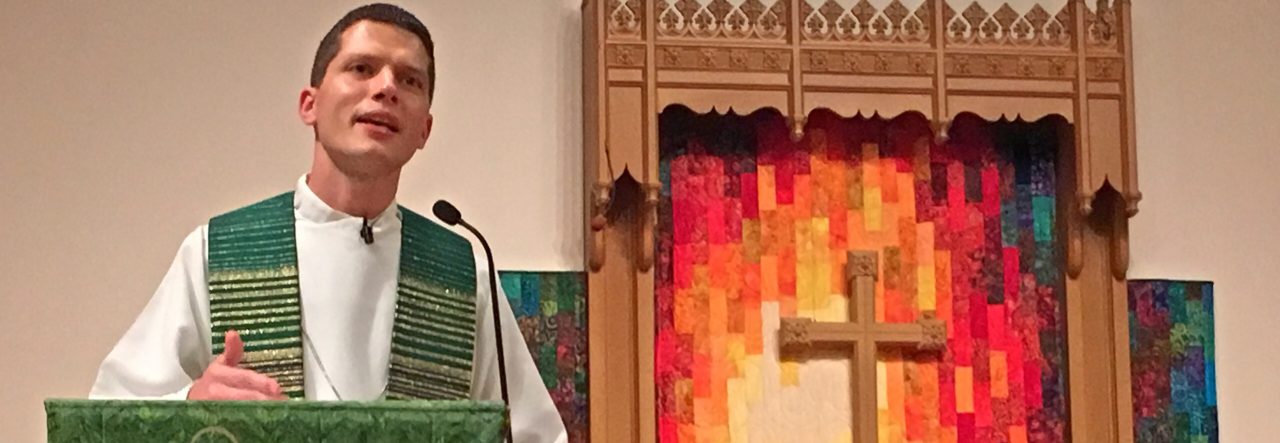
We experience the change-ability of church in the building this weekend at Edina Morningside and Linden Hills UCC. The sanctuary has been transformed into a set for Morningside Theatre Company’s intergenerational production of “Beauty and the Beast”, and worship with communion will take place on that set. This means disruption for those of us leading and participating in worship—where to stand, what microphones work, how to project, whether technology will come through to include folks on Zoom, etc. I can imagine (and have felt myself) occasional dismay that the things we church folk count on to stay the same are shifting instead, requiring extra energy to meet the changing moment. But I also know, trust, and have experienced that what “church” means in the 21st century must morph if we are still to serve God’s people, many of whom are not participating in our traditional forms. I’m proud of how we are practicing flexibility and change, working through discomfort to catch the wind of Spirit. We navigated tech challenges last week with gracious humor, then spent a sacred ninety minutes in the sanctuary afterward sharing our dreams for faith “within, among, and beyond” the church. This Sunday, we will set a communion table right there on the changeable sanctuary stage, a metaphor for all our life together.

I hope you’ll come to see the production that many in the church and community have worked hard on for months. Marvel with me at the gift that a “youth ministry” spirit from a summer theatre camp years ago has morphed into the present moment, where dozens of intergenerational actors and stagehands from the church and neighborhood sing, dance, and create joy for audiences of hundreds. Thank you for trusting the precious gift of this faith community to one another, to me, and to a future church on whose behalf we practice such divine endeavors. Above all, in the poet’s final lines, we trust the “animation of the potter Spirit keeping all things fluid… freeing our joints to be the art of God’s desire”.