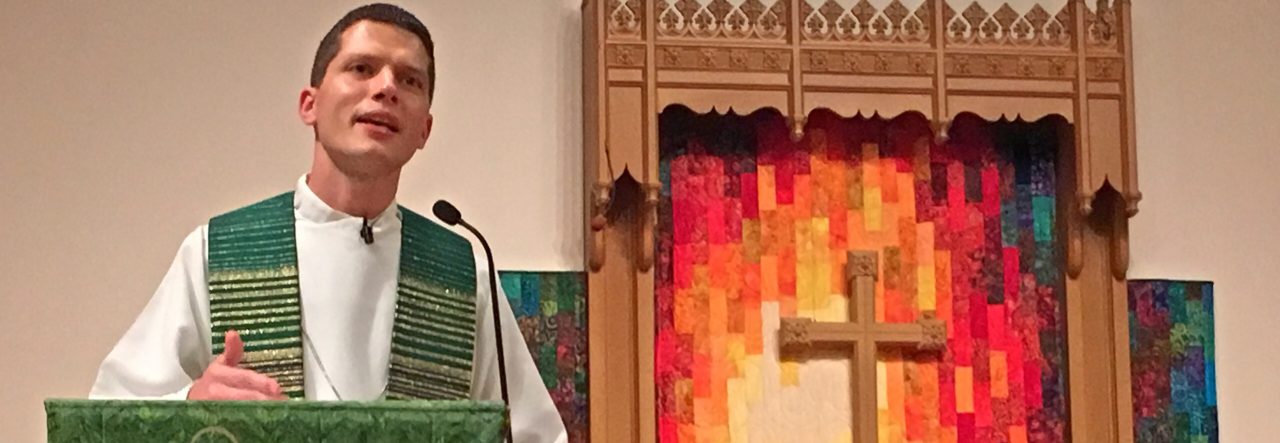
Good morning! Today we begin the book of Romans, the first of many New Testament letters (also called “epistles”) written by Paul or other apostles to specific communities or people, expressing guidance for a given situation. These letters form the rest of the New Testament except for the final book, which we’ll approach in the week after Christmas. Epistles have been judged worthy of inclusion in the New Testament by how well their specific admonitions inform Christian theology (decided largely by vote of councils that convened the Bible’s current contents). These books follow ancient forms of letters or public address, since they were understood to be read aloud in assembly as a substitute for the writer’s actual presence.
Author: Oby Ballinger
Acts 27-28
Good morning! In today’s final chapters of Acts (27-28), we follow along as the apostle Paul laboriously sails to Rome with his unnamed companion, in whose voice much of the journey is recorded. Paul acts as a sort of chaplain to the entire Roman ship, though he is supposedly a prisoner on it. He gives a reliable sense of when it is too hazardous to travel, as the shipwrecked passengers find out almost too late. As the boat is driven by late-season storms (think of those now facing Syrian refugees also seeking ports in Europe), we learn something about ancient maritime customs aboard ship. Paul acts for group cohesion when part of the crew tries to flee in the sole lifeboat, and encourages the hundreds of passengers when it seems all hope is lost. According to the author here, it is Paul’s wisdom (and the overseeing centurion’s mercy) which makes sure all aboard arrive safely on the island of Malta. There again, Paul heroically survives a snakebite that would have felled a lesser man, and cures people of diseases by laying hands on them. Throughout these accounts, Paul takes on a near-mythical status—this reads almost like the adventures of one of the ancient Greek heroes. One wonders what Paul would have made of such a lionizing account, were he alive to read it himself.
Acts 24-26
Good morning! We are nearly done with the travels and travails of Paul, as well as the entire book of Acts altogether. But today in Acts 24-26 we read about his continued captivity in Caesarea, trying to prove his innocence against the false charges brought against him. What most captures the moral imagination in these chapters is the way Paul, by standing firm to his identity and experience, withstands the opposition that tries to throw everything at him. The favor he receives from Roman rulers also goes a long way toward helping him survive years in captivity.
Acts 21-23
Good morning! We have observed the swift expansion of Christianity throughout the book of Acts, especially in the ministry to Gentiles conducted by the apostle Paul. Today in Acts 21-23, we start the final narrative of this book, concerning Paul’s last journey to Jerusalem and from there westward, ending in Rome.
Acts 19-20
Good morning! Today’s passage (Acts 19-20) reads like chapters from a travelogue, describing Paul’s travels in Asia and Jerusalem, then preparing to go on his way to Rome. I confess that I find nothing deeply stimulating in these stories, but take note of several things. First, observe that Paul contends with other populist movements such as that baptizing “into John’s baptism” (presumably John the Baptist). Christianity not only has to define itself against a hostile Jewish elite and polytheist Greek culture, but other purity movements as well. Second, this Christian movement, growing swiftly, continues to arouse resistance such as that which gathers in the theater of Ephesus in a riot. Paul wisely accepts the suggestion that he stay away for the good of everyone, and the riot melts away after a stern address by the unnamed but brave town clerk.
Acts 17-18
Good morning! Today in Acts 17-18 we read about Paul’s second trip through the Mediterranean, this time with Silas and Timothy. He visits some of the sites of his prior trip, checking in on congregations he had planted, but also striking out in new territory.
Acts 15-16
Good morning! Remember a few days ago when the disciples, overwhelmed by the number of Jews and Gentiles to take care of, established a system of deacons? That episode yielded insights into the parallels in how churches then and now respond to concerns, and how their fixes establish precedent for years (sometimes centuries) to come. We have a similar window into ancient church drama today in Acts 15-16, where we see how the disciples respond to the question of whether Gentiles need to follow the same behavioral covenant as Jews.
Acts 13-14
Good morning! With today’s passage (Acts 13-14), we start another major part of Acts—the journey stories of Saul/Paul and Barnabas. The mixed reviews that these apostles get from their audiences show the diversity among Jews and Gentiles. It would be too simple to say that Jews rejected the Jesus tradition and Gentiles embraced it. Rather, some believed and some disbelieved in each community, continuing the productive tension among Christ-followers that is the hallmark of these early Christian decades.
Acts 10-12
Good morning! In yesterday’s reading, I focused on how outsiders kept finding their way inside the community of Christ followers. There’s no greater example of this than how Gentiles came to be equal partners with (and later far outnumbering) Jews in the community of Jesus-followers. That story is told in today’s passage (Acts 10-12), along with a narrative of miraculous salvation from imprisonment.
Acts 8-9
Good morning! I have a lot of favorite passages in the Bible, but the stories in today’s reading (Acts 8-9) contain a number of truly remarkable accounts. I’m inclined to say less and give you more time to just engage the stories, but there’s one theme here that keeps jumping out at me: how outsiders repeatedly find their way into the community of Christ-followers.
 Pastor Oby Ballinger