Preached at Our Saviour’s Lutheran Church (Minneapolis, Minnesota). Texts: Isaiah 9:1-4 and Matthew 4:12-23.
Yesterday morning’s news of another murder by federal agents in our city hit like a ton of bricks. Friday’s statewide, nationwide Day of Truth and Freedom had been such an uplifting experience of solidarity and shared commitment. Fifty-thousand people participated in nonviolent marches, sit-ins, and civil disobedience just here in the Twin Cities, recalling the nation to our values of justice and compassion. But then yesterday, a few violent ICE and Border Patrol officers revisited chaos when they shot and killed Alex Pretti after he was already restrained on the ground. It was a Star Wars reminder that after A New Hope, we see The Empire Strikes Back. These times feel hard and deadly, between the weather and our cruel government bullying and punching down on this embattled state. Our Twin Cities, bearing up under six weeks of a federal onslaught, now has to deal with another senseless murder by ICE. Yesterday was an exhausting scramble to find ways of channeling pain and anguish so our neighbors don’t succumb to violent intentions that cause more harm. How long must we put up with this bleakness? How long, O God?
Within this chaos and calamity, the prophet Isaiah comes alongside us, wraps an arm around our shoulders, and holds us with compassion. Isaiah, the midwife of God’s inbreaking hope, whispers a new future tense that breaks into our foggy overwhelm at what has been. “There will be no gloom for those who were in anguish.” What is now will not always be, because “in the latter time God will make glorious” those places in suffering now. And then Isaiah’s prophetic tense shifts again from future to past, suggesting that transformation is already underway, or has already happened. “The people who walked in darkness have seen a great light; those who lived in a land of deep darkness—on them light has shined.”
For millennia, Christians have recognized Jesus as the great light whom Isaiah foresees. It’s worth remembering that Christ endured, died at the hands of, and sought to redeem his own era of great evil, state violence, and corrupt empire. Herod’s forces murdered all the two-year-old boys in and around Bethlehem in a vengeful, bloodthirsty attempt to kill the Christ child who was visited by magi. Now in Matthew, decades later, Jesus is an adult and state violence remains all around. We hear it referenced, almost taken for granted, at the start of today’s gospel: “when Jesus heard that John had been arrested….” John the Baptizer had made enemies in high places for calling out the sins of the powerful, and for urging people to repent, to adopt lives of radical faith and generous service. Jesus knew John, was cousin to John through Mary and Elizabeth, and had been baptized by John. But now John had been taken captive by colluding religious and imperial forces, jailed to face violent torture and eventual execution.
How does Jesus respond, considering the abduction of someone close to him, on whom the empire visits violence to make an example of by conspicuous persecution? First, Jesus withdraws to Galilee, to the modest regions of tribal Zebulon and Naphtali, the place from which Isaiah saw the light coming to those who live in deep night. Jesus recognizes the importance of taking a beat, making space, and pausing to reground. But second, he begins to preach with the same fervent message as John: “Repent, for the dominion of heaven has come near.” Even in the face of John’s violent arrest and upcoming execution, Jesus joins the proclamation of the prophets before him, announcing divine justice, and the ways of heaven that are to be done on earth. Then third, Jesus begins recruiting, building a movement by calling disciples. We see no record that he waited for just the right people, seeking out the cream of the Galilean crop. He doesn’t interview candidates or make them prove their merit. He does not promise money, fame, or any other signs of success. Rather, like a creative and effective community organizer, he simply meets folks doing their daily labor and puts out the invitation. Walking by the seashore, he interrupts Simon Peter and Andrew while they were fishing. “Follow me, and I will make you fish for human beings.” Two other brothers, James and John, are mending fishing nets when Jesus calls them. The invitation to life-changing discipleship does not often come in mountaintop moments or at the perfect time on a serene retreat. Rather, it’s a compelling invitation right here, right now amid the rest of life: the need is immediate and you’re able to respond or not: “Follow me.”
Did the disciples know what they were in for when they dropped their nets to follow? Did they know the years of itinerancy ahead, the hard teachings, the miracles, the two-by-two discipleship, the tragic execution and triumphant resurrection of Jesus? Of course not—they only knew the person in front of them, the need around them, and the will within them to follow. There was no long-term strategic plan for success, but there was trust in this Jesus, and faith that the way would become clear.
How many of us have received just such an interruptive, ad hoc calling in recent weeks to show up, to follow, to bring our bodies and abilities to the works of Christlike mercy and justice? The summons comes through a phone call from a friend, asking if we can help buy groceries for someone sheltering at home. Whistles and car honks pull us from our other daily activities into observing ICE, recording their raids, comforting their victims, and providing for immediate needs. There’s a Signal notification or text that people are needed now to show up, to deescalate a potentially violent moment, or to act as constitutional observers. We learn that someone needs shelter and we open our doors without knowing how long it will last. Such interruptive, urgent, and open-ended callings bear the mark of Jesus, who still calls disciples from our nets today, saying “follow me”. The preacher and writer Mike Yaconelli once spoke to a youth conference attended by my husband Javen as a teenager. When Javen bought one of his books and asked him to sign it, Mike Yaconelli wrote inside: “May the wild Jesus continue to ruin your life.”
A year ago this week, I had one such experience of starting out, starting over. I felt the need for community organizing that centered LGBTQ people in Minnesota and our needs, so I left a perfectly good job as a parish pastor for unemployment and uncertainty in the launch of Prism Organizing Network. A year later, through countless discerning conversations and co-creative actions, Prism has had almost twenty community listening sessions with over five hundred people in rural and suburban places across the state, sharing what their joys, needs and hopes are for LGBTQ thriving in Minnesota. We have summarized what we are calling for in terms of safety, dignity, and freedom. And now we’re building a Rainbow Road (similar to the Palm Sunday Path) that will lead LGBTQ people and allies into greater organization and effectiveness, showing up in conspicuous ways with regional celebrations for Trans Day of Visibility, Prides and local community festivals throughout the summer, then voter education around school board elections this fall. This has all been improvisational, one step leading to discernment of the next, trying to get comfortable with not knowing where the Spirit is leading. As the way becomes clear, we amend past choices and chart a more informed course. When we learn better we do better, judging by the measures of relationship, integrity and courageous risk-taking.
Faith communities like Our Saviour’s have been key partners in this evolving work. On this Reconciling in Christ Sunday, we celebrate the courage of our forebears and those among us now, who decades ago discerned the call to embrace gay, lesbian, bisexual and trans people into the full life and ministry of this church, and to call for our inclusion everywhere. Today, we also begin a season of re-examining this church’s RIC commitments made decades ago, educating ourselves anew about how the church might minister better with trans and genderfluid people, those who are asexual, and those whose love goes beyond monogamy. We are making space in the vase for every kind of flower in God’s dazzling bouquet. We continue learning alongside Christ and his other disciples what it means to love unconditionally, with the same boldness he demonstrated.
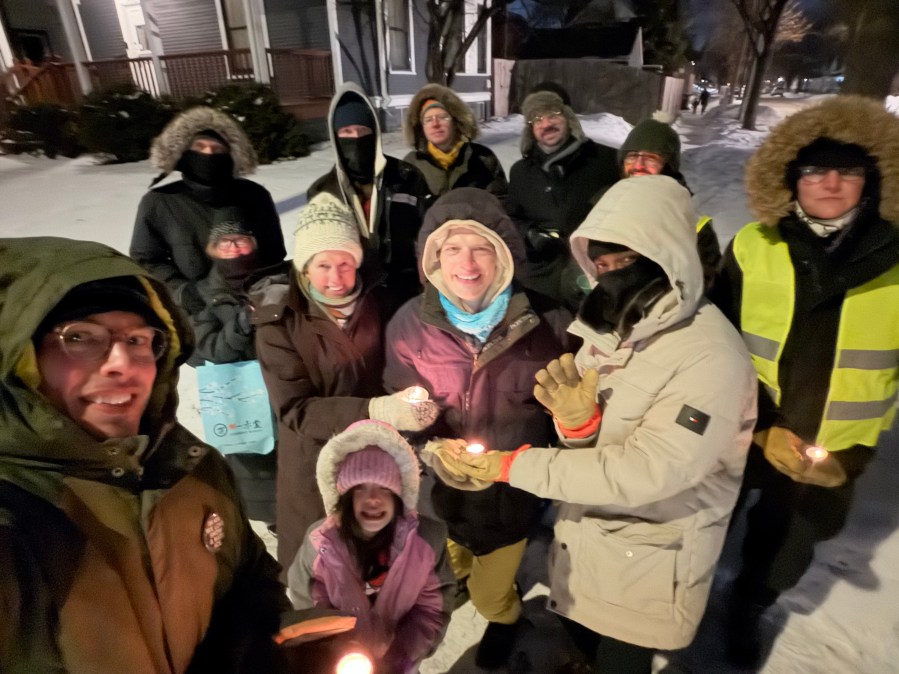
Yesterday we received another ad hoc invitation. After Alex Pretti’s murder, word went out on social media and Signal for everyone to “Shine a Light for Minnesota”. We were invited to go to the corner with candles and create a vigil with our neighbors. There was no plan beyond that, no ten-point protocol for what to do and in which order. There was trust that we knew what to do, and how—so we did. We put the word out to our block, and a dozen neighbors gathered at 7pm for about twenty minutes in the bitter cold. Moving from isolation to community, we brought candles, shared light, and checked in. An elder retiree described watching for ICE out her windows during the day, and a child named her envisioned future where all people help and are helped by each other. From our corner, we could look in several directions and see other candles flickering at other corners. The night was filled with light, the fire of all our candles at countless corners—not hidden but public, not centralized but dispersed, like a prelude to Pentecost. The light shines in the night, and the night has not overcome it.
May the Light of Christ which has called us together this day summon us to follow into a good future still being revealed. May the light illumine new understanding, brighten dim corners, and flame out in new courage. The people who walked in darkness have seen a great light; those who lived in a land of deep darkness—on us light has shined. Amen.
 Pastor Oby Ballinger