Preached at Creekside United Church of Christ (Minneapolis, Minnesota). Text: Matthew 13:33.
Imagine with me that you’re in an aisle of a grocery store, holding one of those rectangular baskets with handles that flip up. Put your hand out like you’re carrying it. (I’ll look less dumb if you join me.) Standing in the baking goods aisle, you reach for a five-pound bag of flour, and place it into the empty basket. Feel the weight as the powdery paper sack drops into it. Now, imagine that’s one terrible news headline, one calamitous thing, landing heavy as a bag of flour in your basket. How many other headlines and stories are you carrying after these last few weeks? Bombs dropping in Iran and missiles in Israel. Disinvestment in medical research, veteran services, disaster relief, suicide prevention. Five pounds, five pounds, five pounds. The supermarket basket is too full for more, but there’s additional pounds to come. Open your arms wide to a great bushel basket now—it can carry more. Add to it the pounds from Supreme Court decisions, ICE abductions, wildfire smoke, and political assassination. Palestinians murdered waiting for their sacks of flour. Do you feel the weight? You’re holding this awkward bushel basket, needing both hands, moving gingerly, so heavy in your arms, and unable to do anything else. How much are you carrying, the piled-up woes of the world this week? Fifty, sixty, seventy pounds—what to do with all that weight? There’s so much potential in the flour—enough to make more than a hundred loaves! But by itself the flour is just inert, dead weight.
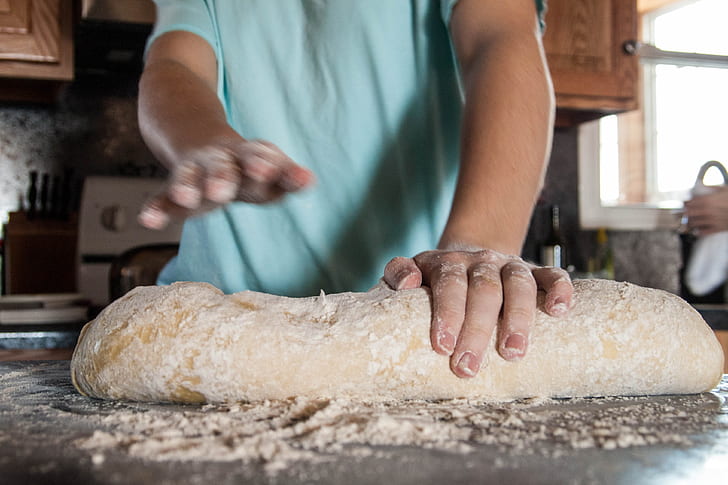
Jesus says the kingdom of heaven is like a woman who hides yeast or leaven in that great mound of flour. Three measures was a bushel basket full, fifty pounds or more. It was the upper limit of what one person could carry or work with. And what’s up with the leaven? They didn’t have little packets or jars of yeast, after all. Jewish biblical scholar Amy-Jill Levine describes the leaven of that time as something like sourdough starter. It was intentionally allowed to ferment and doesn’t sound particularly appealing. She says, “the idea of sour smell combined with a bubbly mixture created by the process of fermentation—that is, enzyme decay—does not immediately strike [one] as palatable. To the contrary, there’s an ‘ick’ factor at play.”[1]
The kingdom of heaven is like that, like leaven hidden into a great mound of flour? When Jesus refers to leaven here and elsewhere in the Christian scriptures, it carries the connotation of being somewhat off. There is an intentional “corruption” with leaven, something out of the ordinary. The preacher Tom Long puts it this way: “The parable of the yeast pictures the kingdom as a hidden force, working silently to ‘corrupt’ the world—that is, to corrupt the corruption.”[2] Because if this world’s empires leave us with a bushel basket of dreadful headlines, transforming that into the divine realm will take bubbly, fizzy, unusual intervention. “God is fermenting the empire of the heavens within the world,” writes Gary Peluso-Verdend, “like the woman who mixes—or spoils—flour with yeast.”[3] In other words, leaven can transform flour into dough for bread, but it’s a little queer.
That potent word used to simply mean something which differs from the norm, something strange, unusual, odd, eccentric, or unconventional. The word had valences of being questionable, suspicious, and corrupting. Applied to people whose sexual orientation and gender identity fall outside the norm, it was intended to be derogatory, but our communities have claimed it with pride. Jesus describes that which transforms as yeasty leaven that differs from the rest. We don’t fit like anyone else, and that’s exactly the point. We queer people belong—are vitally necessary; we are agents of God’s realm. Our straight allies recognize it too, collaborating like the woman in Jesus’ parable, acting to hide and mix in the leaven until the whole kit and caboodle is transformed. Working together, we are part of how God brings about the realm of heaven from within.
Lesbian, gay, bisexual, and transgender people do not conform to the norm. We are an oddness by which God intends to bless the world. Victoria Safford, a Unitarian minister serving in Mahtomedi, points to how this happens. She describes earlier Pride marches, back in the bad old days when one could lose one’s job for being a member of the queer community. (I guess that’s the bad new days also.) Safford describes both the peril and the promise of queer visibility, saying:
“To march was a dangerous risk—but not to was a risk of another kind—of living half-dead, with no name, unremembered, in the dark, surviving on scraps and crumbs and the outright threats and pious ultimatums of the hate-filled present moment. Why not risk all that, and walk out into the sun in the summer and walk around in the world as it ought to be, thereby bringing it to bear? Why not march and carry on, act out, act up, as if your life depended on it?”[4]
The gift that LGBTQ people bring to the rest of the world is liberating unconventionality. We take the risks of being visibly different, and we make it normal for more people to live beyond the conformist status quo as well. Marianne Williamson describes how infectious it is when you live fully as yourself.
“You are a child of God. Your playing small does not serve the world. There is nothing enlightened about shrinking so that other people won’t feel insecure around you. We are all meant to shine, as children do. We were born to make manifest the glory of God that is within us. It’s not just in some of us; it’s in everyone. And as we let our own light shine, we unconsciously give other people permission to do the same. As we are liberated from our own fear, our presence automatically liberates others.”
Over the past few years, we’ve seen worsening threats to queer people, from bathroom bills and book bans to legal erasure, healthcare denial, and military expulsion for transgender people. The Trevor Project runs a national hotline for youth and young adults at risk of self-harm, and they report that in the 24 hours after the last presidential election, calls to their suicide prevention hotline went up 700%. This week we learned that the Trump administration is shutting down a similar hotline, leaving some of our most vulnerable community members to die. But we are not hiding in closeted fear. We are working to transform those terrible headlines with the powerful leaven of LGBTQ visibility and community organizing.
In January I left parish ministry to create a new multifaith and multiracial statewide organizing effort for LGBTQ liberation. I’ve called it Prism, naming it after that little triangular object that makes visible the rainbow spectrum always present—though hidden—everywhere there’s daylight. Prism organizing, likewise, seeks to make visible the rainbow communities that are already present everywhere in Minnesota. LGBTQ people are already in every faith, place, race, speaking every language, and from every ZIP code in Minnesota. Prism is how we will connect, support, organize and train ourselves and our allies for LGBTQ protection, equality, and liberation—now and in the years to come. Creekside has already been an early partner in this work, hosting our public launch and including us as your special offering recipient this month—thank you!
You may or may not be a queer person, or called to LGBTQ organizing. But the parable of the leaven invites you to embrace whatever your misfit characteristic is, and see it as an essential small way that the great world is transformed. To repeat Marianne Williamson, “as we let our own light shine, we unconsciously give other people permission to do the same.” So let your freak flag fly, whatever that is. Be a light in the eyes, a peal of laughter in solemnity, or bright flower in a field. Be unconventional, misfit, bubbly, and queer like yeast, that you might serve the purposes of transformation. Just as you are, you exist to leaven the weighty cares of the world, making something tasty and nutritious.
Remember the three measures of flour where the woman hides that transforming leaven? Amy-Jill Levine points out that huge amount of flour would be “far too much for one woman to knead on her own, and the yield would be far too much for one person to consume.”[5] More likely, that amount would have been shared by a group of people working together to bake bread at a communal hearth. They would have had a common interest in the rising leaven, and each would have shared the role of kneading, shaping and baking the dough, until all the village was fed by the action of hidden yeast working its transformation. This is what Jesus says the realm of God is like, in Levine’s words: “present at the communal oven of a Galilean village when everyone has enough to eat. It is present, inchoate, in everything, and it is available to all, from the sourdough starter to the rain and the sunshine.” May God inspire us with such a vision—the generative yeast of divine transformation hidden right here—and enlist us to do our part for the feeding of the world. Amen.
[1] Amy-Jill Levine, Short Stories by Jesus, New York: HarperCollins (2015), 122.
[2] Thomas G. Long, Matthew, in the Westminster Bible Companion series, eds. Patrick D. Miller and David L. Bartlett (Louisville: Westminster John Knox, 1997).
[3] Gary Peluso-Verdend, “Theological Perspective,” in Feasting on the Word: Preaching the Revised Common Lectionary, Year A, Vol. 3, eds. David L. Bartlett and Barbara Brown Taylor (Louisville: Westminster John Knox, 2011), 284.
[4] Victoria Safford, “The Small Work in the Great Work”, in The Impossible Will Take a Little While, ed. by Paul Rogat Loeb; New York (Basic Books, 2004), 184.
[5] Amy-Jill Levine, 133.
 Pastor Oby Ballinger