Good morning! We close out Leviticus today in chapters 26-27 with an extended discussion of the consequences for following or breaking the covenant, then an encore discussion of offerings.
Month: February 2016
Mortification of the Body
Community United Church of Christ (Saint Paul Park, Minnesota)
Scripture: Mark 9:30-37
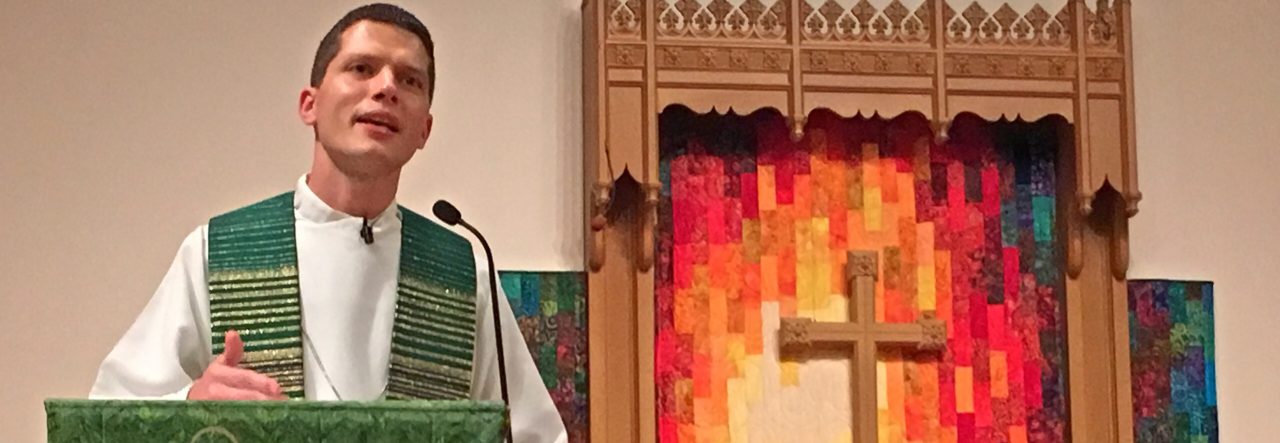
I started thinking about tonight’s sermon a few days ago at the gym. (Sometimes I listen to sermon podcasts while I’m exercising—though sometimes it’s Lady Gaga.) Anyway, whenever I’m at the gym I’m surrounded by people working to build power, stamina and endurance. Body-builders honing the curve of their biceps or the square of their pectorals. Rugged women and men push around a metal “sled” with hundred-pound weights on it. Old men breathlessly battle one another on the racquetball courts. Personal trainers coach people of all body types to do just five reps more. And on the walls are giant murals celebrating strength and fitness. This modern-day temple to muscle and physique was a very strange place to “remember that you are dust, and to dust you shall return”.
But where does one go in our culture to reflect on death? Were it not for occasional funerals or driving by cemeteries, most of us could go years without much reminder of bodily decay and death. Indeed, our world actively promotes getting stronger, faster and more powerful forever. It’s not just gym culture or the physical body—“success” comes in many forms. As children we learn that what matters is getting good grades. While teenagers, we count the number of friends we have, or how soon we can get the driver’s license. Savvy professionals count our retweets, Facebook follows, blog posts and the development of a personal brand. Promotions at work and take-home pay become the measures of merit for professionals. If we are fortunate enough to reach the age and ability to retire, many feel the loss of meaning that often comes with being out of the workplace. We make up for it with cultural experiences, travel, the exploits of grandchildren, and our different areas of volunteer leadership, including here at church.
None of these are bad pursuits in and of themselves. But when they are the only things a person can dwell on, or when taken too far, they end up creating problems. Without a robust sense of mortality, our priorities get warped and we chase after ephemeral things. Those who lack “greatness” in the areas of physique or status or accomplishment live with feelings of insecurity. Those with medical difficulties feel they have to minimize or hide the trouble for fear of appearing weak. When we face the death of loved ones, if we have had little chance to encounter mortality, we can be frightened by its finality. Too many reach the end of our lives, and we resonate with the poetry of T.S. Eliot: “I have seen the moment of my greatness flicker, / And I have seen the eternal Footman hold my coat, and snicker; / and I am afraid.” Chasing after success in all the usual ways without holding these in tension with mortality leaves us fragile and fearful when our powers fail.
This is the gift of Ash Wednesday, then, and the Good News of this night. Jesus turns the measures of greatness on their head. Success doesn’t have to look like accomplishments, awards, promotions, or all the other accolades that we are taught to pursue. Nobody could collect all of those things in the first place, which means that even the most outwardly-successful person could feel like a failure. Instead, Jesus says “Whoever wants to be first must be last of all and servant of all.” He brings a child into their midst, and says that welcoming a child is like welcoming God’s own Self. Remember that children of this time had no special status. Preacher Raquel Lettson explains, “The child is devoid of any legal rights and has no societal protection or maintenance except that which the parent can provide. The child cannot offer patronage or other critical social benefits. Ultimately, children are dependent on the goodwill of others. S/he is completely vulnerable. …To welcome one such as this is honorable. This is ‘greatness’ according to Jesus.”[1] The point is summed up another way by Oprah Winfrey: “Not everyone can be famous, but everyone can serve.”
The greatness of faith will not look like the greatness you can read about in the Forbes 500 lists. It is a greatness of compassion, of daily life lived well, of embracing those who are least and lost and left out. And we start to see this, paradoxically, when we encounter mortality. The surgeon Atul Gawande wrote a book several years ago called Being Mortal: Medicine and what Matters in the End. Gawande suggests that instead of running away from the truth about death, or hiding the mortification of the body with another dozen pushups at the gym, there’s much to gain when we face the facts of life and death. He suggests that “acknowledging your mortality is a tremendous gift. It reorders your desires. It narrows your focus, and gives you a new perspective that’s rooted in reality instead of vain hope for a medical miracle.”[2] Mortality is our reminder that we do not have forever on this earth, and that what matters most is how we serve and welcome Christ in young and old alike.
Can I let you in on a little secret then? Every year on Ash Wednesday, I hear something that scrambles my brain. As I’m marking the cross on someone’s body, someone is bound to say a gentle, whispered “thank you.” It strikes me as odd, but it happens every year. Perhaps, though, this is a quiet acknowledgment of the mystery which God is able to work through ash and dust. “Thank you” for reminding us of death, because we can thereby focus on what really matters in life. “Thank you” for acknowledging the reality of pain and loss when it seems like no place else will. “Thank you” for making space for wounds and hurts alongside worldly success. “Thank you” for the promise that even as the body declines, the spirit grows ever greater. “Thank you” for the reassurance of our faith, that nothing is too fearful for God, not even death.
Let us pray: Holy God, giver of life and conqueror of death, you know that none of us will make it out of this life alive. Open our eyes to the wisdom of Christ, that we may wear his cross of ash and join him in the great service of his way. Amen.
[1] Raquel S. Lettson, “Commentary on Mark 9:30-37” posted at WorkingPreacher.org. Available at: http://www.workingpreacher.org/preaching.aspx?commentary_id=2581.
[2] As described by Dan Clendenin, “To See Death Daily” post on the Journey with Jesus website. Available at http://www.journeywithjesus.net/Essays/20150216JJ.shtml.
Leviticus 24-25
Good morning! Leviticus 24 and 25 are almost the end of this book. They show us how Levitical theology informs criminal punishment and property practices.
Leviticus 21-23
Good morning! In case you’re counting, there are just two more days of Leviticus after today! (I just checked.) This has been fun, but we’re ready to move on, right? Soon enough, I promise. Today in Leviticus 21-23, we hear more about the role of priests, separating lay people from clergy, and then read about the main Hebrew festivals appointed throughout the year.
Leviticus 19-20
Good morning! Today’s reading of chapters 19-20 continues what’s called the “holiness code” in Leviticus. Yesterday’s reflection ran long, so let me keep this one to the point.
“Listen to Him!”
Community United Church of Christ (Saint Paul Park, Minnesota)
Scripture: Mark 8:27-9:8
For the last five weeks, I’ve been coaching a group of people on Facebook who are reading through the Bible in a year. Genesis was fascinating for several weeks last month, and Exodus was pretty good too, but this week we’ve really hit the skids—it’s Leviticus. I’d forgotten just how many laws are in Leviticus. The book goes on for chapter after chapter with instructions for animal sacrifices, inspecting houses, dealing with skin diseases, and other unsavory topics. Yet group members bring even these readings to life with their wisdom and personal stories. Earlier this week we discussed how the beautiful and intricate priestly garments must have become horribly stained by day after day of sacrifices. It led into conversation about the marks that life’s work leaves on our clothes and our bodies. How do stains and marks give witness to the work we’ve done well (or otherwise)? One person, Carolyn, says: “I find that the marks that are left from my work as a clinical social worker (now retired) are on my mind and heart…after journeying with people through the pain of abuse, family dissolution, etc. etc. I can still feel the sadness of many of those people.” Cynthia Miller wrote about her father, who was a coal miner: “His clothes would be so dirty & greasy that my mother would not wash them at home less they wreck her washer & dryer; she took them separately to our town’s only laundromat once a week. My father worked very hard to pay for college for my brothers and me because he once said he wanted us to have the kind of jobs where we shower before work, not after. My dad is a loving & faith-filled man, and I never forget his sacrifices for our family.”[1] Both these are examples of the costs that come with serving our deep desire for another’s gladness. Ask a parent, a teacher, or anyone else whose life’s calling is much more than just work. If you love deeply, you will suffer much for that love.
Leviticus 16-18
Good morning! Today’s passage (Leviticus 16-18) begins with a description of an annual atonement ritual, then continues to describe divine laws for the Hebrews to follow. In so doing, Leviticus lays the groundwork to justify later violence against non-Hebrews who break these laws. It proceeds from the assumption (shared by the entire sacrificial system) that violence against creature or human being is appropriate and God-blessed so long as it upholds a distinction between the righteous “us” and the sinful “them”.
Leviticus 14-15
Good morning! This section of Leviticus is where we earn our merit badges! Passages like today’s in Leviticus 14-15 have me wondering about the wisdom of reading the entire Bible in a year. Thankfully, modern medicine has advanced significantly beyond these ancient treatments for skin and reproductive system disorders. I read with curiosity for how other cultures might have treated similar situations, and how these remedies might have indirectly helped the health of the whole people.
Leviticus 12-13
Good morning! Today in Leviticus 12-13 we hear about birth practices for mothers of newborns, and then a variety of interventions prescribed for skin and mold diseases. While this is perhaps interesting from a medical point of view, I find little here that is resonant of the Divine and much here that makes me grateful for modern medicine!
Leviticus 10-11
Good morning! We have two more chapters of Leviticus today, and these are ones we may find challenging to keep as divinely-inspired “Scripture” rather than simply literary relics of an earlier time. Leviticus 10-11 confronts us again with the distance between (one version of) ancient Hebrew spirituality and our own understandings.
 Pastor Oby Ballinger